
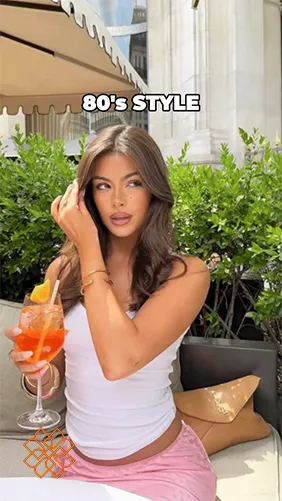
ساخت عکس دهه ۱۹۸۰ میلادی (یا همان دهه ۱۳۶۰ ایران) با هوش مصنوعی چند روزی است که فید اینستاگرام را پر از پرترههای نوستالژیک با موهای پرحجم، رنگهای گرم و بافت فیلم قدیمی کرده؛ کافی است یک عکس امروزی را به چتجیپیتی بدهید و بخواهید آن را به دهه ۸۰ ببرد.
در این مقاله میخوانید:
- آموزش تصویری و گامبهگام ساخت این عکسها در هوشا
- ۱۰ نمونه پرامپت آماده و تستشده با عکس خروجی هرکدام
- نکاتی برای نتیجه طبیعیتر و مناسب انتشار در اینستاگرام
عکس دهه ۸۰ با هوش مصنوعی چیست و چرا در اینستاگرام ترند شده است؟
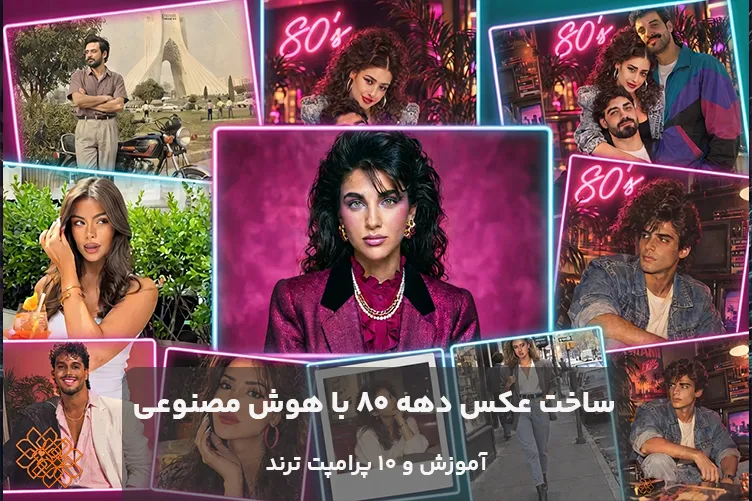
عکس دهه ۸۰ با هوش مصنوعی یعنی بهجای گذاشتن یک فیلتر ساده روی عکس امروزیتان، از چتجیپیتی بخواهید کل صحنه مدل مو، لباس، نور و حتی بافت فیلم را طوری بازسازی کند که گویی عکس واقعاً در دهه ۱۹۸۰ گرفته شده است.
نکتهای که این ترند را از یک فیلتر معمولی متمایز میکند، تأکید صریح روی حفظ چهره است: کاربران در پرامپت خودشان میخواهند ویژگیهای صورت و هویتشان دقیقاً همان بماند و فقط دنیای اطراف عوض شود.
این عکسها چطور ترند شدند؟
این ترند از طریق استیکر «Add Yours» در استوری اینستاگرام بهسرعت بین دوستان و فالوورها پخش شد؛ همین ویژگی چرخه اشتراکگذاری آن را خیلی سریعتر از یک ترند معمولی کرد.
خروجیهای این ترند طیف گستردهای دارند: از پرترههای استودیویی رسمی و عکس مجلهای گرفته تا عکس یادگاری خانوادگی و فضای دیسکو. نور گرم، رنگهای قویتر، فوکوس نرم و بافت کمی محو از مشخصههای مشترک همه این خروجیهاست.
اگر برایتان جالب است بدانید که هوش مصنوعی از یک متن ساده چطور به یک عکس کامل میرسد، پیشنهاد میکنیم مطلب پرامپت چیست را هم بخوانید.
نوشتن پرامپت عکس دهه ۸۰
اگر میخواهید بهجای استفاده از پرامپتهای آماده این مقاله، سناریوی اختصاصی خودتان را بنویسید، راهنمای پرامپتنویسی عکس دقیقاً برای همین منظور نوشته شده و اصول نوشتن یک پرامپت کامل را آموزش میدهد.
۱۰ نمونه پرامپت عکس دهه ۸۰ میلادی (عکس دهه شصتی)
همه پرامپتهای زیر از منابع اختصاصی و تستشده تیم هوشا هستند و میتوانید هرکدام را عیناً کپی کنید. برای دیدن مجموعه کاملتری از سناریوهای مشابه، مطلب پرامپت عکس را هم ببینید.
استایل ۱. پرامپت ساخت عکس دهه شصتی با المانهای نوستالژیک تهران
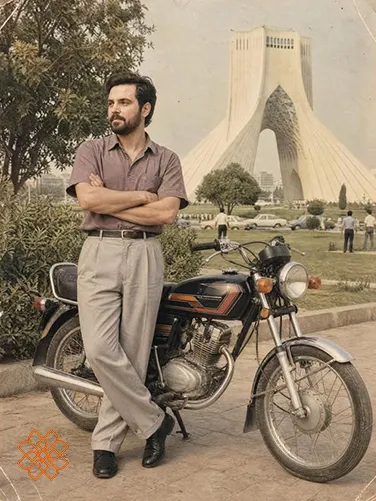
| Create ONE photorealistic vertical 3:4 image of the person in the uploaded IDENTITY REFERENCE standing with folded arms beside a vintage black commuter motorcycle in the landscaped grounds of Azadi Tower, Tehran. Reconstruct the scene below as a faded Iranian family-album color photograph with the visual character of the Iranian 1360s / 1980s era, preserved as an aging physical print. It must feel like an ordinary photograph taken at that place, with coherent perspective, natural anatomy, period clothing, and authentic material wear. REFERENCE ROLES The uploaded person’s photograph is the IDENTITY REFERENCE. If the old Azadi Tower photograph is also supplied, use it as the SCENE REFERENCE for composition, pose, clothes, motorcycle, architecture, lighting, colors, and print wear. Never use the scene’s original person as the new identity. If only the identity photograph is supplied, reconstruct the environment from this specification. Produce one coherent photograph with one foreground subject. IDENTITY AND BODY Depict the same recognizable person as the identity reference. Preserve their facial proportions, forehead, hairline, eyebrows, eye shape and spacing, nose, lips, jaw, chin, ears, cheek structure, distinctive marks, natural asymmetries, complexion, and apparent age. Preserve their visible body build: shoulder width, neck length, torso volume, and limb thickness. Do not automatically reproduce the original subject’s slim male physique. Tailor the specified clothing to the uploaded person’s body while retaining its period cut. Respect the person’s apparent gender presentation. Infer unseen anatomy conservatively. Apply the scene’s light and faded colors to the person’s actual complexion. Keep the face at the same photographic softness as the rest of the image, with naturally integrated edges, neck, and shadows. No identity blending, pasted face, beautification, or reshaped features. HAIR AND FACIAL HAIR The scene’s hair reference is dense, dark, slightly wavy hair with a high rounded swept-back front, full crown, shorter non-faded sides, and a longer feathered nape: a restrained period quiff with a subtle mullet-like back. Adapt this styling where compatible with the uploaded person’s hair, preserving their natural hairline, color, texture, and identifying characteristics. Sweep compatible hair back with natural volume; brush longer hair away from the face and behind the shoulders as needed. Respect sparse or absent hair. Avoid a modern skin fade, carved barber lines, wet gloss, or an exaggerated wig. Preserve the uploaded person’s own facial hair or clean-shaven appearance; never impose moustache on everyone. FRAME AND COMPOSITION Use exactly 3:4 portrait orientation, with square pixels, for example 1536 x 2048. Naturally recompose the approximately square source scene for the taller frame; do not stretch or squeeze it. Keep the complete hair, both shoes, the entire front tire, and the tower’s crown and arch inside the frame. Use additional vertical field for plausible sky and paving, without excessive empty space, sidebars, a square inset, or a thick border. Place the person left of center in the foreground, head around the upper-left third and shoes close to the bottom. The motorcycle is immediately to their image-right, partly behind their lower body, extending diagonally toward the lower-right foreground. Its front wheel is the closest wheel. Azadi Tower stands in the upper-right background, its crown higher than the person’s head, with its arch largely unobstructed. A leafy tree fills the upper-left corner behind the head; thick shrubs fill the left middle ground. Grass, small pedestrians, and a low band of old cars separate the foreground from the monument. Approximate portrait layout, subordinate to natural proportions: person x=16-46%, hair y=16-20%, shoes y=92-95%; tower x=51-98%, crown y=11-14%, base y=39-42%; front-wheel center near x=80%, y=82%, lowest tire edge near y=97%. The rear wheel is partly hidden behind the trouser legs. Leave edge clearance; do not align the tower with the person’s head. Do not mirror the left-person/right-motorcycle arrangement. POSE AND EXPRESSION The person stands casually upright beside the rear seat, almost touching it at the hip, with relaxed shoulders and weight shifted onto one supporting leg. The torso is approximately front-facing with a slight turn toward image-right. Fold both arms comfortably across the lower chest, just above the waist: one hand rests against the opposite upper arm with several relaxed fingers visible; the other hand is mostly tucked beneath the opposite arm. Show correct elbows, overlapping forearms, subtle skin compression, and a visible belt below the arms. Cross the legs loosely around the lower shins/ankles, one leg passing diagonally in front of the other. Both shoes meet the pavement naturally, one toe angled slightly outward. The person is standing, not sitting or straddling the motorcycle; neither hand holds a handlebar, and neither foot rests on the bike or curb. Keep the pose relaxed and anatomically plausible. Turn the head toward image-right into a gentle three-quarter view, with the gaze directed outside the frame approximately level or slightly raised. Expression: composed, serious, quietly self-assured, closed lips, no smile. Keep enough of the face visible to recognize the identity. No direct eye contact or theatrical expression. SHIRT A muted dusty mauve / smoky purple short-sleeved collared button-up shirt with gray-brown undertones and slight uneven fading. Everyday woven fabric, mostly matte with mild sheen on sunlit folds. Comfortably loose through the torso and sleeves; sleeve hems end above the elbows, slightly open around the upper arms. Include a conventional pointed collar, one or two undone upper buttons, a narrow central placket, small dark buttons, and a discreet patch pocket on the wearer’s left chest, viewer-right, partly hidden by the folded arms. Collar points are relaxed and subtly asymmetrical. Tuck the shirt into the high waistband, with small gathers and soft bunching above the belt. Show vertical chest wrinkles, compression below the forearms, and diagonal tension toward the waist. No graphics, logos, rolled sleeves, tie, jacket, or prominent undershirt. TROUSERS, BELT, AND SHOES Very full, high-waisted light warm-gray trousers, dove-gray / stone-gray with a faint beige cast. Medium-weight, softly draping woven suiting fabric with fine restrained texture, not a prominent pattern. The waistband sits at the natural waist. Include belt loops, several deep front pleats, generous hips and thighs, long falling folds, and legs that taper toward the ankles. The crossed pose creates broad diagonal folds at the knees and shins and slight gathering near modest turned-up cuffs. Retain the voluminous period silhouette while fitting the person’s actual build. No denim, skinny fit, cargo pockets, elastic cuffs, or low rise. Use a narrow-to-medium dark leather belt with a simple rectangular, slightly tarnished silver-toned buckle warmed by the color cast. Keep belt and buckle visible at the front waist. Shoes are worn black leather lace-up low shoes, rounded to slightly squared toes, creased vamps, modest stitching, low heels, and subdued sheen. Dark socks appear only where naturally visible. No sneakers, boots, sandals, jewelry, sunglasses, bag, helmet, or wrist accessory. MOTORCYCLE: FORM AND ORIENTATION A small older utilitarian street motorcycle with classic 125-class commuter proportions: black body and tubular frame, angular orange-red tank graphics, exposed silver single-cylinder engine, wire-spoked wheels, chrome parts, and a long black bench seat. Match the visible machine, without modernizing or customizing it. Do not fabricate a precise manufacturer or model from illegible badges. Its rear extends behind the person’s hip and legs toward image-left; its front points image-right and slightly toward the camera. Show a three-quarter side/front view with the near side of the tank and engine visible. The front wheel is prominent in the lower-right; the rear wheel looks smaller and is partly occluded by the trousers, frame, and exhaust. All parts connect mechanically and share consistent perspective. The bike is stationary on a dark metal center stand, with descending supports and feet contacting the pavement beneath the engine. MOTORCYCLE: TANK, SEAT, AND REAR An elongated near-black tank, gently rounded on top, with subdued gloss and a small metallic filler cap. Its near side carries an orange-red angular stepped/chevron-like graphic framing a black inset, with thin cream/tan pinstripes and nearly horizontal orange bands along the lower section. The graphic is distinct but naturally faded by the old print. A small pale maker’s wordmark lies near the upper-middle side; when the scene reference is available, preserve its visible shape and softness. If unreadable, keep it indistinct, never invent clearer branding or random text. A long one-piece black vinyl bench seat extends leftward from the tank behind the person’s hip. It has rounded edges, shallow transverse seam/rib impressions, worn upholstery wrinkles, and a dull top highlight. Include a slender metallic rail or trim beneath its edge. The black side cover below has horizontal vent-like ridges and a tiny faded red-and-cream rectangular badge with inconspicuous lettering. Show the visible rear coil-spring shock, triangular dark frame members, rear spokes, rubber footrests, and ordinary connections. No luggage or added accessories. MOTORCYCLE: ENGINE AND EXHAUST An exposed air-cooled silver-gray single-cylinder engine with stacked horizontal cooling fins, a slightly inclined cylinder, rounded lower crankcase, small fasteners, dark seams, hoses, cables, and oil-darkened recesses. The aluminum is used and slightly oxidized. A curved chrome header descends from the front of the cylinder, curls below the engine, and continues rearward into a low cylindrical chrome exhaust on the visible side. Include the near-side rubber foot peg and ordinary metal control levers. Keep the mechanical forms recognizable but naturally softened by the photographic medium. No impossible mechanics or polished restoration finish. MOTORCYCLE: FRONT, LIGHTS, AND WHEELS Two slender metallic telescopic fork legs, correct steering geometry, visible brackets, and a close-fitting curved chrome/silver front mudguard. Add aged reflections and a dark trailing mudflap where visible. The front tire is narrow dusty black-gray rubber with ordinary shallow tread. A thin metallic rim and many fine wire spokes connect correctly to a large round silver drum-brake hub and axle. The wheel is slightly elliptical only because of perspective, never warped. Keep the whole tire inside the frame. Rear wheel construction matches. No disc brakes, alloy wheels, or off-road tires. Above the mudguard, one large circular headlamp with a chrome rim, dark rear housing, and slightly cloudy ribbed clear glass reflecting daylight; the light is off. A round amber-orange indicator sits on each side on a short mount; the nearer one is slightly more prominent. Include a smaller round amber reflector lower on the near side by the fork. Use curved chrome handlebars, black rubber grips, slender silver levers, and dark control cables arcing down toward the steering head. A silver lever projects toward image-right. A small black cylindrical instrument housing sits behind and above the headlamp. No tall mirrors, windscreen, LEDs, or digital dashboard. AZADI TOWER The recognizable Tehran monument in the upper-right background, viewed near-frontally at a slight oblique angle across landscaped grounds. Pale ivory stone, tall central mass, broad flaring supports, and sweeping curved lines rising inward from the ground. Preserve the deep pointed central opening, darker inner passage, and interlacing/ribbed geometric stonework above and around the inner arch. Keep these patterns fine and subdued at this distance, with continuous, structurally plausible supports. The crown is a restrained near-rectangular upper block with a subtly stepped silhouette, vertical grooves/ribs, and short rows of small dark window-like slots near its upper face. Lower sides flare into the lawns. Show delicate stone joints and vertical-to-curving linework, warm cream highlights, and gray-olive shadows inside the arch. The stone is not brilliant digital white. Small trees overlap parts of the base, while the arch and crown stay readable. The tower is softer and lower contrast than the person and bike through atmospheric distance, yet architecturally intelligible. No pasted edges, redesigned arch, or substitute landmark. Behind it, include a faint low-rise skyline of indistinct rectangular buildings in haze. No Milad Tower, skyscrapers, cranes, signs, flags, or extra landmarks. TREE, SHRUBS, AND LAWNS A large dense tree fills the upper-left corner and left edge behind the person’s head. Small olive-green leaves, irregular branches, and several slim gray-brown trunks show through gaps. The canopy is naturally clipped by the top and left edges. Dense waist-high shrubs sit behind the legs and near the seat, with many small narrow oval/lance-shaped leaves, muted yellow-green highlights, and lifted olive-brown interior shadows. Leaf shapes and spacing are irregular rather than repetitive. Beyond them, dull green lawns show slight dryness and uneven yellow-olive patches. Include low planted borders, small round-canopied trees, and occasional narrow upright shrubs. A rounded medium tree overlaps the tower’s lower-left base; smaller trees punctuate the grounds and roadside. The park feels maintained but ordinary, with no extravagant flowers, tropical plants, or unnaturally lush greens. BACKGROUND PEOPLE AND CARS A handful of tiny incidental pedestrians: a cream-shirted figure seen from behind around the central garden; a muted blue-shirted figure with dark trousers toward the right lawn/path; another light-shirted figure near the far-right edge; and a few much smaller distant figures. Keep their faces unresolved and their presence secondary. No additional foreground portrait subject or duplicate of the uploaded person. A low horizontal band of old boxy passenger cars crosses the road/parking area beyond the nearer lawn: faded cream, off-white, pale gray-blue, and subdued dark vehicles with simple period silhouettes. They are small, hazy, and partly obscured by planting and people. No modern vehicles or readable plates. PAVEMENT AND CONTACT Warm beige-gray stone/concrete paving with broad rectangular slabs, worn joints, faint cracks, dust, and subtle discoloration. A low rough gray-beige curb separates shrubs from paving, running diagonally from the lower-left behind the person toward the middle-right behind the motorcycle. Leave visible pavement around the shoes, stand feet, and complete front wheel. Place all contacts correctly on one ground plane. Show aligned shadows from the person, wheels, spokes, fork, and stand, predominantly toward image-right. Add small darker contact shadows beneath shoes, tires, and stand feet. Nothing floats, penetrates the curb, or casts inconsistent shadows. CAMERA AND LIGHTING An informal outdoor snapshot, framed from approximately the standing person’s chest-to-eye height with a level camera and normal-lens perspective, roughly a 40-55 mm full-frame-equivalent visual impression. This is a visual guide, not original camera metadata. No lens distortion, tilted horizon, low-angle hero shot, or cinematic exaggeration. Moderate depth of field and gentle optical softness: the person and motorcycle are clearest, foliage retains texture, and the distant tower, people, cars, and skyline soften progressively. No creamy portrait-mode bokeh or artificial segmentation around the hair. Warm hazy daylight comes from high in front and toward camera-left, illuminating the face, forearms, shirt folds, trousers, tank, and metal naturally. Keep readable facial form and moderately defined ground shadows with slightly softened edges. Haze reduces contrast without producing flat overcast lighting. The sky is almost featureless pale gray-beige with a faint yellow-green cast, without dramatic clouds or saturated blue. No sunset, flash, rim glow, or lens flare. COLOR AND PHOTOGRAPHIC RESPONSE Faded color photography, warm cream/yellow cast, subtle olive-green bias; not monochrome sepia. Preserve distinct subdued colors: dusty mauve shirt, stone-gray trousers, olive/yellow-green foliage, aged black motorcycle paint, restrained brick-orange/red striping, amber indicators, warm gray chrome, cream tower, beige paving. Apply this common treatment while preserving the identity’s underlying complexion. Low-to-moderate saturation; weakened blues; greens shifted toward olive; blacks slightly lifted toward brown-charcoal; gently compressed highlights rolling into cream. Retain separation within the dark tank, seat, foliage, and engine. No crushed blacks, HDR microcontrast, teal-orange grading, intensely saturated colors, or artificially orange skin. Fine irregular film grain and very light aged-print/scanning texture cover the image, including sky and shadows. Use modest resolution softness and restrained edge acuity. Keep the identity, cloth construction, wheel geometry, and architecture readable instead of smearing them. Add subtle uneven fading, a few minute dark dust specks, tiny pale abrasions, and faint discoloration, especially in the sky and near edges. Avoid heavy grunge and evenly repeated scratch overlays. PAPER EDGES AND WEAR The result reads as a straight-on reproduction of the entire old paper photograph, filling almost the whole canvas. Include gently rounded corners and a very narrow irregular off-white/beige worn perimeter, with a barely visible darkened outer lip where appropriate. No wide white mat, Polaroid caption band, frame, tabletop, album page, hand holding the photo, or perspective view of the print. Localize delicate branching creases and hairline abrasions near the upper-left, upper-right, and lower-left corners. Add restrained rubbing along the lower and right edges. Include one faint, broken, pale diagonal surface scratch in the gap between the person’s image-right upper arm and the handlebar area, descending toward image-right. These marks sit on the print surface, not in the photographed environment. Keep wear irregular and unobtrusive, without a prominent tear across the face. FINAL CONSISTENCY Prioritize recognizable reference identity and plausible body; folded arms and crossed ankles; the exact period outfit; the left-person/right-motorcycle arrangement; black tank with angular orange-red graphics, round headlamp, silver engine and spoked front wheel; recognizable Azadi Tower and layered park; unified faded color and worn print texture. All elements share one exposure, one perspective, and one aging process. No captions, dates, subtitles, signatures, watermarks, invented readable text, duplicated parts, extra limbs, distorted architecture, cropped shoes or front wheel, painting, CGI surfaces, hyper-sharpening, or contemporary fashion-editorial finish. Deliver one complete vertical 3:4 vintage color photograph. |
استایل ۲. پرامپت ساخت عکس دهه شصتی با نورپردازی نئونی
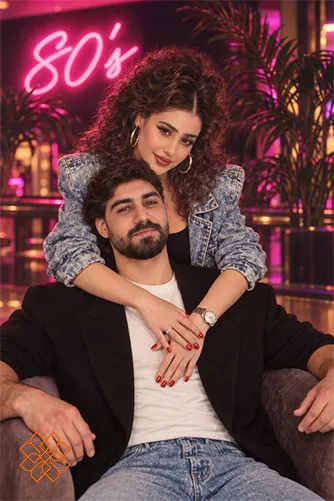
| Edit this photograph: restyle the couple into a 1980s mall-studio portrait. Same people, same pose, same frame. CHANGE: 1. Her hair: replace the slicked-back bun with a big teased 1980s perm — voluminous dark brown curls, deep side part, blown-out layers framing both cheeks, hairspray shine, volume rising above the crown and falling past the shoulders. Large gold hoop earrings. 2. Her wardrobe: replace the white blazer with an acid-wash stonewashed denim jacket, padded shoulders, sleeves pushed up the forearms, over a black scoop-neck top; the sleeves follow the identical line of her draped arms. 1980s makeup: peach blush high on the cheeks, strong brow, glossy red lipstick, glossy red nails on the same hands. 3. His hair: replace the short fade with 1980s volume — thick dark hair, long on top, blown back in soft waves, sides grown out over the ears, natural shine. His beard, moustache and hairline stay exactly as in the original. 4. His wardrobe: replace the black t-shirt with a plain white crew-neck tee under an oversized black wool blazer with 1980s padded shoulders and sleeves pushed up, collar open; jeans become light stonewashed blue denim. 5. Environment: replace the grey panelled wall, wooden console, candles and dried flowers with a night-time 1980s mall lounge — dark backdrop, a glowing hot-pink neon script sign reading “80’s” on the wall behind her shoulder, tall potted palm fronds behind them, magenta and violet neon reflections falling out of focus into depth. 6. Grade: 1980s warm photo-lab print — amber and magenta cast, soft neon bloom, fine print grain, gentle vignette, slightly lifted blacks. Palette 60% warm amber and denim blue, 30% deep charcoal, 10% hot magenta neon. PRESERVE EXACTLY: – Both faces pixel-for-pixel: bone structure, eyes, nose, lips, skin tone, his beard, her features and expression. Both faces fully uncovered, eyes clearly visible, nothing worn over the eyes. ONLY CHANGE hair, clothing, background and colour grade — pose, framing and identities 100% identical. |
استایل ۳. پرامپت دهه 80 با استایل اسپرت و وینتیج
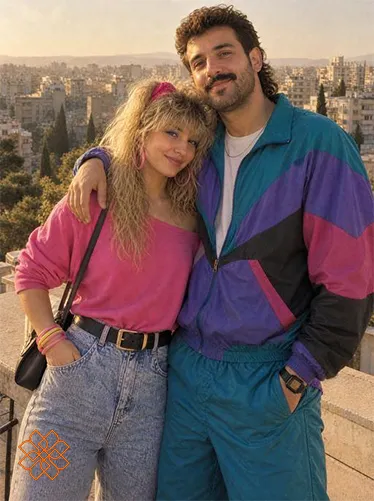
| Edit the image: convert this couple portrait into a late-1980s photograph. Only hair, wardrobe and background change — the same two people, same pose, same framing. CHANGE: – Her hair: big teased late-80s blonde perm, heavily crimped voluminous fringe over the forehead, high side ponytail gathered in a hot-pink fabric scrunchie, loose backcombed strands catching the backlight. Blue-lilac eyeshadow, peach blush, glossy pink lip. – The sunglasses on top of her head are removed; teased hair fills that area continuously. – Her clothing: slouchy off-the-shoulder hot-pink brushed-cotton sweatshirt, sleeves pushed up, bare left shoulder, tucked into high-waisted acid-wash denim jeans with a wide black leather belt and gold buckle. Oversized pink plastic hoop earrings, stacked yellow and pink plastic bangles on her wrist. Her bag becomes a plain unbranded black leather 1980s shoulder bag, identical size and strap line across her body. – His hair: 1980s mullet, short and voluminous on top, curly length falling over the collar at the back; thick moustache with light stubble. – His clothing: unbranded colour-blocked nylon shell tracksuit jacket in teal blue, purple and magenta with black panels, zipped halfway over a plain white cotton t-shirt; matching teal nylon track pants replace the jeans; thin gold chain at the neck; chunky black plastic digital watch replaces the modern one. – Background: late-1980s . Same sun position, same backlight direction, same shallow background blur. – Overall render: 1980s 35mm colour film photograph, warm golden-hour halation, slightly soft vintage lens, fine natural grain, warm skin tones. PRESERVE EXACTLY: – Both faces and identities 100% identical – The pose 100% identical as the reference image ONLY hair, clothing and background change. 100% identical otherwise. |
استایل ۴. پرامپت عکس دهه 80 در فضای کافه
| Transform the people in the uploaded photograph into authentic, stylish 1980s versions of themselves, while preserving the original location, composition, and their exact identities. Make the transformation clearly visible through period hairstyles, clothing, accessories, and photographic rendering. IDENTITY AND ANATOMY Preserve each person’s exact facial structure, apparent age, skin tone, distinctive features, expression, and gaze. Keep their original head size, body proportions, pose, hands, and limb positions. Everyone must remain immediately recognizable. Do not reshape faces, invent facial hair, smooth away age, or distort anatomy. 1980s MAKEOVER Give each person a convincing, individually suited 1980s makeover: noticeably period-appropriate hairstyles, fashionable clothing, and coordinated accessories. Where compatible with the person’s existing hair, use authentic volume, feathered layers, waves, curls, or swept-back styling. Preserve hair color and natural hairline; respect baldness and thinning hair. Choose clothing appropriate to the original occasion, drawing on rich leather, denim, satin, textured fabrics, relaxed tailoring, structured shoulders, open collars, and bold period colors. Select a coherent outfit for each person rather than combining every trend. Use era-appropriate jewelry and eyewear where suitable. Apply period makeup only when appropriate to the subject’s existing presentation and age. Keep the look confident, natural, and fashionable—not an exaggerated costume. KEEP THE ORIGINAL SCENE Retain the exact location, background elements, objects, camera angle, framing, crop, and arrangement of people. Preserve poses, interactions, and anything held in the hands. Do not create a studio backdrop, nightclub, neon signs, or a different environment. Fit the new clothes and hairstyles naturally around the existing bodies and overlapping subjects. AUTHENTIC ANALOG PHOTO Render the same scene as a believable 1980s color-film photograph: warm skin tones, rich colors, fine visible film grain, gentle optical softness, slightly softened highlights, and natural photographic contrast. Preserve the scene’s original lighting direction and time of day. Where compatible with the original light, introduce the subtle character of an on-camera flash snapshot. Apply the photographic treatment consistently across the people and their existing surroundings. Keep faces detailed and recognizable. Avoid heavy color filters, excessive blur, plastic skin, and modern beauty retouching. Do not add text, dates, captions, logos, borders, scratches, or social-media interface elements. The result should feel like a genuine photograph of these same people, at the same ages, in the same place and poses, wearing authentic 1980s fashion—with a substantial style transformation and faithful facial identity. Aspect ratio 3:4 |
استایل۵. پرامپت ChatGPT برای ساخت عکس دهه ۸۰ با افکت پلاروید
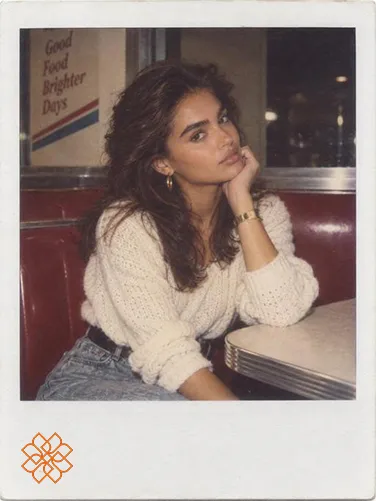
| What would a Polaroid of me taken in the 1980s look like? Create one authentic-looking instant photograph of the person in the uploaded image, with a complete and believable 1980s transformation. Preserve their identity, age, facial anatomy, proportions, skin tone, and distinctive facial features. Use the source only to establish who they are. Independently invent a new period hairstyle, outfit, grooming approach, and accessory selection. Make substantial changes to both hair and clothing, keeping all choices coordinated and suitable for a real person of the same age. Capture a casual, specific moment in a simple period setting. The person might be sitting, leaning against something, or pausing during an ordinary activity. Choose one setting and action naturally, without adding elaborate props or a crowded background. Use a medium or three-quarter composition, a relaxed expression, slightly imperfect framing, and plausible instant-camera exposure. Include gentle optical softness, characteristic instant-film color, and realistic skin texture. Keep the face clear enough to recognize. Present the image as a single straight-on instant print with an off-white border and a wider lower margin. Let the print fill the output without a tabletop or a hand holding it. The photograph should look recently developed during the 1980s, not heavily aged decades later. Avoid scratches, excessive yellowing, modern objects, studio glamour posing, and an unchanged outfit hidden beneath a vintage filter. |
استایل ۶. پرامپت 1980s ChatGPT برای پرتره کلاسیک مردانه
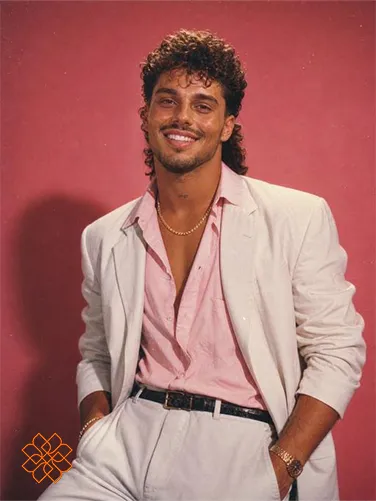
| What would I look like if I lived in the 1980s? Transform this photo into an authentic, realistic 1980s portrait, as if the photograph had actually been taken during that era. Preserve the person’s identity, facial features, facial structure, proportions, skin tone, and distinctive characteristics exactly, so the person remains clearly recognizable and closely resembles the original photo. Give the subject a look inspired by authentic 1980s fashion and beauty: big, voluminous hair with a realistic hairstyle from that era, glamorous and stylish 1980s clothing, period-appropriate accessories, and a polished, attractive appearance inspired by fashion magazine portraits of the time. Use authentic 1980s studio lighting, a warm magenta or pink backdrop, vibrant and saturated colors, direct studio flash, soft contrast, natural skin texture, subtle analog film grain, and the visual characteristics of 35mm film photography. The image should look like a genuine photograph taken in the 1980s, not a modern photograph with a vintage filter applied. Do not change the person’s face or identity. Do not change their age, facial proportions, or distinctive facial features. Avoid plastic-looking skin, excessive retouching, cartoonish effects, artificial-looking details, or modern fashion and photography aesthetics. The final result should feel natural, glamorous, nostalgic, stylish, and completely believable—as if this person had genuinely been photographed in the 1980s. |
استایل ۷. پرامپت خلاقانه برای ثبت عکس دهه شصتی با استایل جین
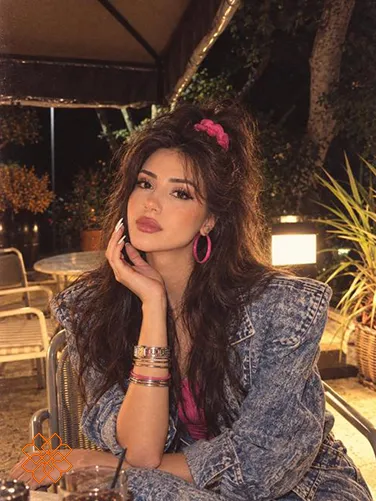
| what would I look like in the 1980s. Keep my face recognizable and make everything else authentically 1980s. |
استایل ۸. بهترین پرامپت عکس دهه ۸۰ برای عکاسی خیابانی و استریتاستایل
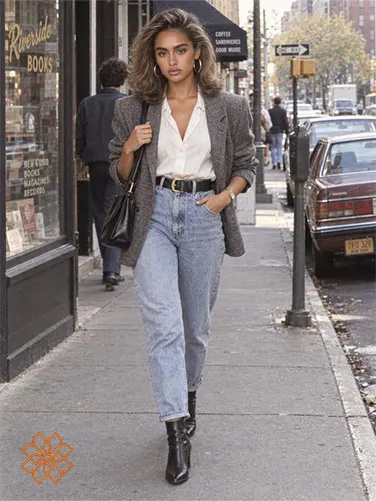
| What would I look like walking down a street in the 1980s? Transform the person in the uploaded photo into a fully reimagined 1980s version of themselves in a candid, full-body street photograph. Preserve their identity, age, facial anatomy, proportions, skin tone, and distinctive facial characteristics. Maintain believable anatomy and natural body proportions. Completely redesign their visible appearance from head to toe. Independently choose a cohesive period hairstyle, outfit, footwear, grooming approach, and accessories. Do not preserve the original hair or clothing as styling constraints. Choose from the broad variety of real everyday 1980s fashion rather than defaulting to neon, sportswear, or one familiar stereotype. Coordinate the silhouette, fabrics, colors, shoes, and accessories as the personal choices of one real individual. Capture them mid-step or just as they turn toward the photographer. Keep their face sufficiently visible and sharp to recognize. Use a natural walking posture and show the complete outfit without cropping the shoes. Place them on a modest, believable urban street with a few accurate period details and no dominant landmarks or distracting crowd. Keep the environment secondary to the person. Use a vertical composition, available daylight, plausible 35mm street-photography characteristics, natural skin texture, and slight movement in clothing. Avoid runway posing, studio backdrops, modern vehicles or devices, exaggerated nostalgia props, face changes, and a transformation achieved only through photographic color. aspect ratio 3:4 |
استایل ۹. پرامپت عکس دهه ۸۰ با تم ویدیوکلاب قدیمی
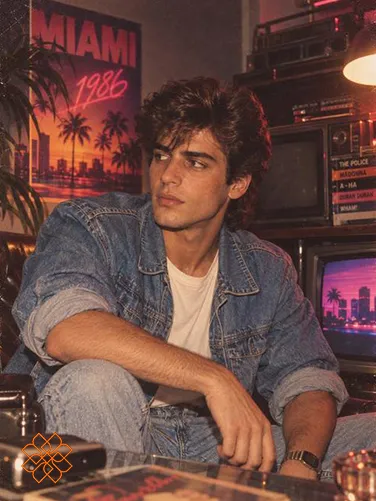
| A high-quality, Iranian 1980s-style retro-vintage portrait of the person in the reference image. Preserve the face, facial features, skin tone, and identity exactly as they are, without making any alterations. Depict the subject with an authentic 80s aesthetic: a classic 80s hairstyle, vibrant 80s fashion, grainy 35mm film texture, warm vintage color grading, soft neon ambient lighting, a flash photography style, high detail, and masterpiece quality. |
استایل ۱۰. پرامپت ساخت عکس دهه ۸۰ با استایل مد و فشن پر زرقوبرق
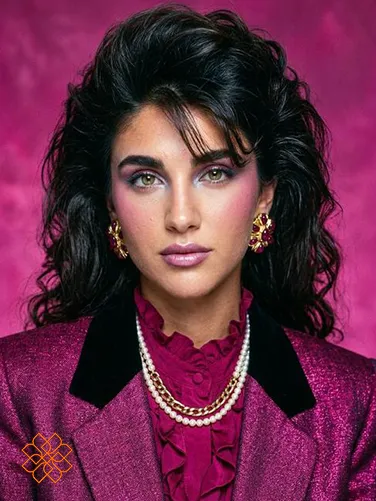
| What would I look like if I lived in the 1980s? Transform this photo into an authentic, realistic 1980s portrait, as if the photograph had actually been taken during that era. Preserve the person’s identity, facial features, facial structure, proportions, skin tone, and distinctive characteristics exactly, so the person remains clearly recognizable and closely resembles the original photo. Give the subject a look inspired by authentic 1980s fashion and beauty: big, voluminous hair with a realistic hairstyle from that era, glamorous and stylish 1980s clothing, period-appropriate accessories, and a polished, attractive appearance inspired by fashion magazine portraits of the time. Use authentic 1980s studio lighting, a warm magenta or pink backdrop, vibrant and saturated colors, direct studio flash, soft contrast, natural skin texture, subtle analog film grain, and the visual characteristics of 35mm film photography. The image should look like a genuine photograph taken in the 1980s, not a modern photograph with a vintage filter applied. Do not change the person’s face or identity. Do not change their age, facial proportions, or distinctive facial features. Avoid plastic-looking skin, excessive retouching, cartoonish effects, artificial-looking details, or modern fashion and photography aesthetics. The final result should feel natural, glamorous, nostalgic, stylish, and completely believable—as if this person had genuinely been photographed in the 1980s. |
آموزش ساخت عکس دهه ۸۰ یا عکس دهه شصتی با هوش مصنوعی در هوشا
همه ۱۰ پرامپت بالا را میتوانید مستقیماً در استایلهای آماده هوشا پیدا کنید و بدون کپیکردن دستی، با یک کلیک امتحان کنید. این استایلها روی همان مدلهای قدرتمندی اجرا میشوند که پشت چت جی پی تی هم هستند، با این تفاوت که در هوشا به فیلترشکن یا کارت ارزی نیاز ندارید. برای آشنایی با گزینههای بیشتر، بهترین ابزارهای ساخت عکس را هم بررسی کنید.
ورود به هوشا
برای شروع، کافی است وارد این هوش مصنوعی آنلاین شوید؛ صفحهای که مستقیماً از سایت هوش مصنوعی هوشا هم در دسترس است.
۱. وارد سایت hoosha.com شوید و به بخش «تصویر» بروید.

انتخاب استایل
در هوشا بخش هوش مصنوعی ساخت عکس استایلهای آماده مربوط به دهه ۸۰ را پیدا کنید؛ همه پرامپتهای این مقاله دقیقاً همینجا و بهصورت استایل آماده در دسترساند و میتوانید خودتان آنها را با یک کلیک امتحان کنید.
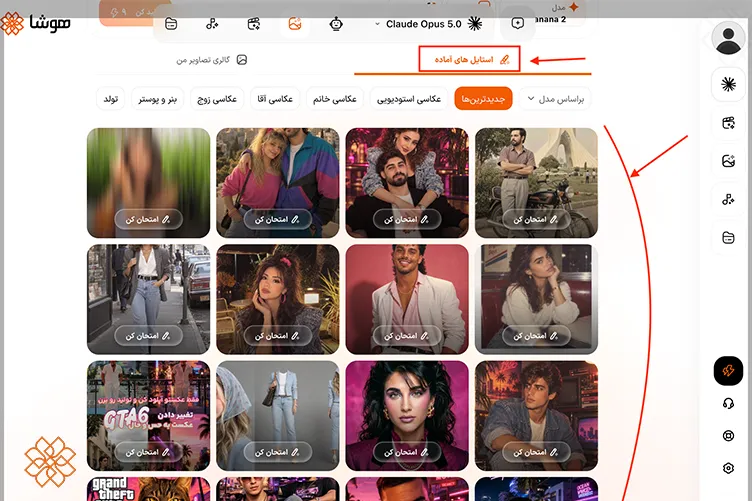
۲. عکس مرجع خودتان را آپلود کنید و استایل دهه ۸۰ موردنظر را انتخاب کنید.
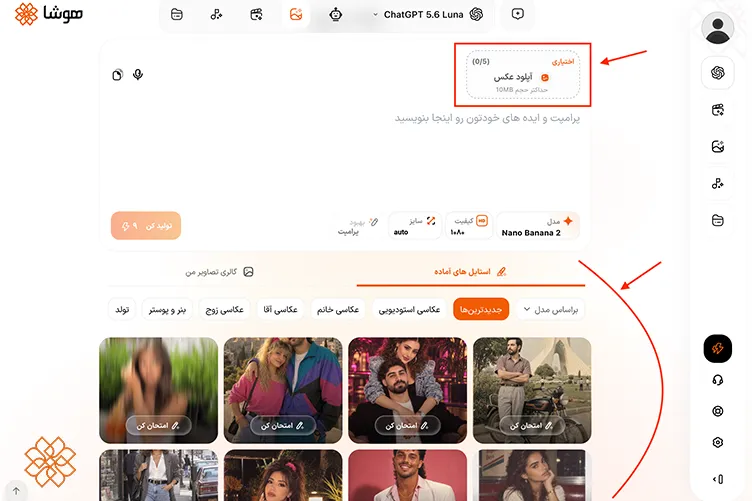
۳. در صورت نیاز، جزئیات لباس، مدل مو یا لوکیشن را در کادر متنی ویرایش کنید.

۴. روی «تولید کن» بزنید و خروجی را بررسی کنید.

نکات مهم برای دریافت نتیجه بهتر از ساخت عکس دهه شصتی
- از یک عکس مرجع روشن، روبهرو یا با زاویه کم بگیرید و در پرامپت درخواست حفظ ویژگیهای چهره را اضافه کنید.
- جزئیات لباس، مدل مو، لوکیشن، نور فلاش و نسبت تصویر را دقیق مشخص کنید تا خروجی حدسزده نشود.
- اگر نتیجه اول کامل نبود، همان خروجی را مرحلهبهمرحله و با تغییر یک یا دو جزئیات اصلاح کنید، نه اینکه هر بار از صفر شروع کنید.
- برای راهنمای کاملتر درباره تنظیمات و گزینههای مدل، مطلب ساخت عکس با چت جی پی تی را هم مطالعه کنید.
همین الان یکی از پرامپتهای بالا را کپی کن و ساخت عکس خودت را شروع کن.
نویسنده: معین معرک نژاد
برای ساخت عکس دهه ۸۰ با هوش مصنوعی به عکس مرجع نیاز دارم؟
خیر، اما عکس مرجع واضح باعث میشود ویژگیهای چهره و ترکیببندی به نتیجه دلخواه نزدیکتر شود. فقط از تصویری استفاده کنید که حق استفاده از آن را دارید.
پرامپت عکس دهه ۸۰ را فارسی بنویسم یا انگلیسی؟
ابتدا پرامپت دقیق انگلیسی را کامل امتحان کنید. اگر جزئیات استایل درست اجرا نشد، عبارتهای کوتاه و ضروری مانند 1980s یا film grain را به آن اضافه کنید.
چطور خروجی را طبیعیتر کنم؟
جزئیات لباس، مدل مو، لوکیشن، نور فلش و نسبت تصویر را مشخص کنید. سپس همان خروجی را مرحلهبهمرحله اصلاح کنید، نه اینکه هر بار از ابتدا شروع کنید.
 جی پی تی لایو GPT-Live-1 چیست؟ معرفی مدل صوتی جدید OpenAI
 Gemini 4 Pro جمنای ۴ پرو چیست؟ تاریخ انتشار و شایعات
 ساخت عکس دهه ۸۰ میلادی با چت جی پی تی (ترند اینستاگرام)؛ آموزش و ۱۰ پرامپت
 میلیاردر شدن با هوش مصنوعی؛ چرا تیم آرمو AI را موج بعدی ثروت میداند؟
 رنگی کردن عکس با هوش مصنوعی؛ مقایسه بهترین ابزارها + آموزش عملی
